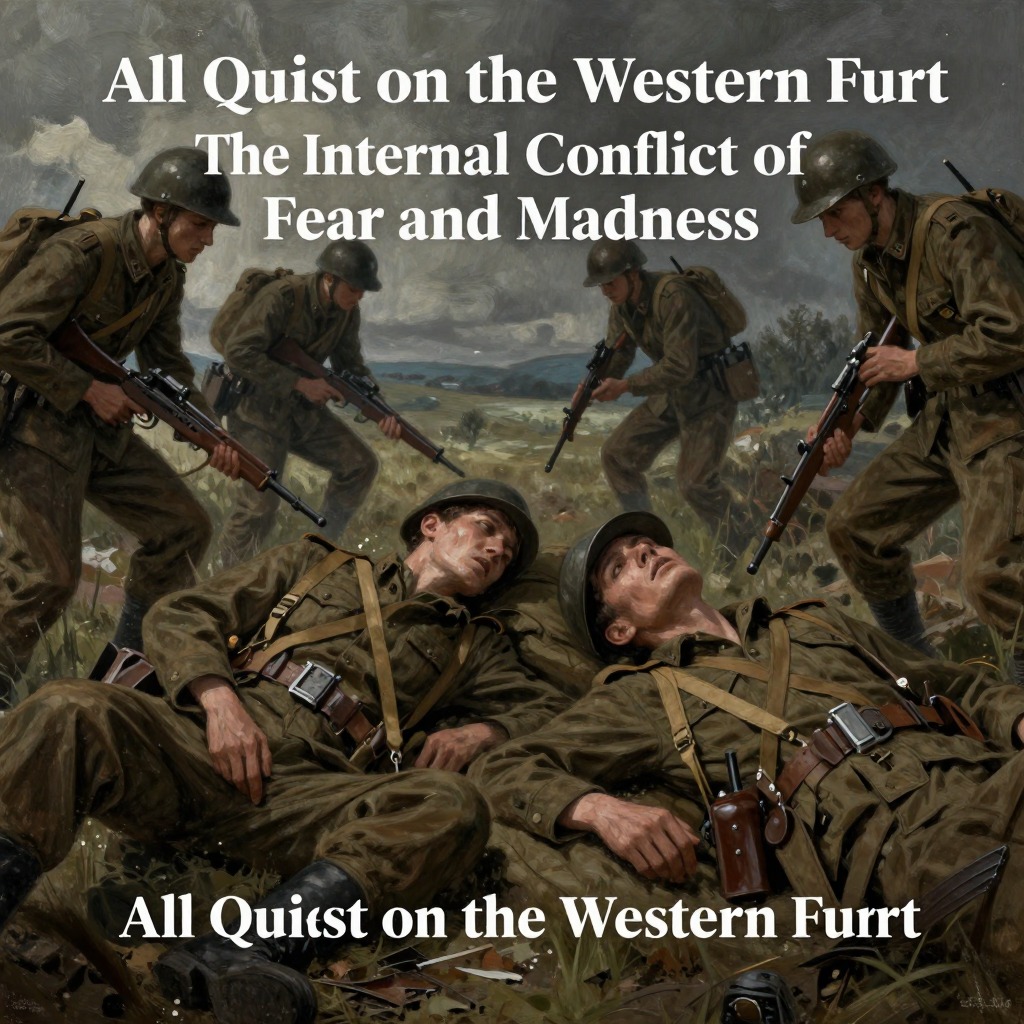
Berger's Rescue
Berger's Rescue is a desperate, self-sacrificial action in which the soldier Berger, driven by a form of front-line madness, retrieves a second machine-gun from a nearby crater during a surrounded attack, enabling a counter-attack that saves his comrades, before later dying from a wound sustained while attempting to shoot a wounded messenger-dog.
Background and Context
By the summer of 1918, the war had devolved into a bitter struggle from crater to crater, with no proper trench warfare remaining. The front-line had been penetrated everywhere, and small groups fought from clusters of shell-holes. The German army was emaciated and starved, its food bad and mixed with substitute stuff that caused dysentery. The artillery was fired out, with too few shells and worn barrels that scattered so widely they fell on their own men. Fresh troops were anaemic boys who could not carry a pack but merely knew how to die by thousands. Against this, the enemy had too many fresh English and American regiments, too much corned beef and white wheaten bread, too many new guns, and too many aeroplanes. It was in this context of collapse that Berger's action took place.
What Happens
Berger and his comrades were in a crater, with the English coming down obliquely, turning their flank and working in behind them. They were surrounded. Fog and smoke hung over them, making surrender impossible, and perhaps they did not want to give themselves up—a man did not even know himself at such moments. The explosions of hand-grenades came towards them. Their machine-gun swept the semicircle in front of them, but the cooling-water evaporated. They hastily passed round the case, and every man pissed in it, thus obtaining water to continue firing. Behind them, the attack crashed ever nearer. A few minutes and they would be lost. Then, at closest range, a second machine-gun burst out. It was set up in a crater alongside them. Berger had fetched it, and now the counter-attack came over from behind; they were set free and made contact with the rear.
Consequences and Aftermath
Afterwards, as they lay in comparatively good cover, one of the food-carriers reported that a couple of hundred yards distant there lay a wounded messenger-dog. Berger asked where, and the other described the place to him. Berger went off either to fetch the beast in or to shoot it. Six months earlier he would not have cared; he would have been reasonable. His comrades tried to prevent him. As he went off grimly, all they could say was, "You're mad," and let him go. For these cases of front-line madness became dangerous if one was not able to fling the man to the ground and hold him fast. And Berger was six feet and the most powerful man in the company. He was absolutely mad, for he had to pass through the barrage; but this lightning that lowered somewhere above them all had struck him and made him demented. It affected others so that they began to rave, to run away—there was one man who even tried to dig himself into the ground with hands, feet, and teeth. Berger, who meant to finish off the dog, was carried away with a wound in the pelvis, and one of the fellows who carried him got a bullet in the leg while doing it. The rescue had saved his comrades, but the same front-line madness that drove him to it also led to his own death.
Thematic Significance
Berger's action exemplifies the extreme psychological pressure of the front-line, where the boundary between heroism and madness dissolves. The same instinct that enabled him to fetch the machine-gun and save his comrades—a reckless, almost demented disregard for personal safety—also drove him to his death over a wounded dog. The narrative presents this not as simple courage but as a symptom of a deeper breakdown, a "front-line madness" that could strike anyone. Berger's fate, like that of Detering who deserted over a cherry tree, shows how the war eroded the very foundations of rational self-preservation, turning men into beings who could act with extraordinary bravery and equally extraordinary folly, often in the same moment. The rescue itself, however, stands as a testament to the comradeship that was the finest thing to arise out of the war—a bond that made men risk everything for each other, even when all hope seemed lost.